How to Split a Bill With Different Orders
Learn a step-by-step method to split a restaurant bill when orders vary, dividing shared items, calculating tax and tip, and reconciling checks.
Everyone at the table ordered something different. Some shared nachos, two split a pitcher, and one friend just had soup. Now the check sits in the middle, waiting. Don’t worry. This guide explains how to split a restaurant bill with different orders using a clear, repeatable method. You’ll assign items, share costs, handle tax and tip, and make sure every dollar matches the receipt.
What Information Do You Need Before Splitting a Restaurant Bill?
Start with an itemized receipt. It lists every dish, drink, and price. You’ll also need the tax amount, any discounts, and the tip percentage your group wants.
Next, know who ordered what. Jot notes during the meal if your group is large. It’s also helpful to agree on the tip rate before the bill comes. That prevents awkward debates later.
How Can You Assign Each Menu Item to the Correct Person?
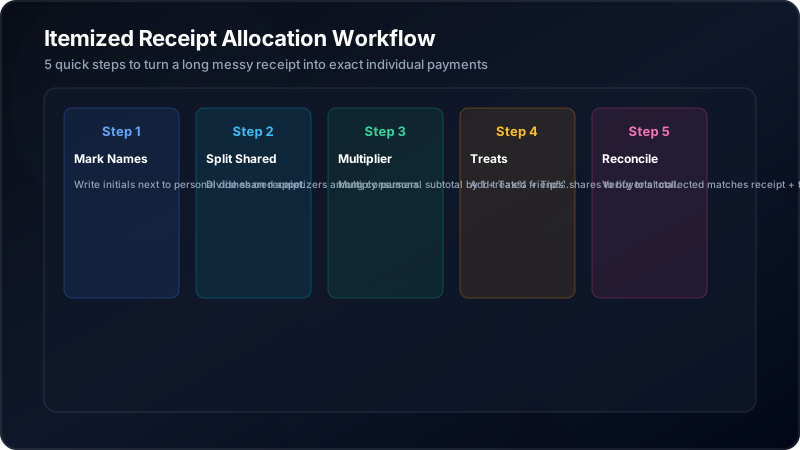
Go line by line through the receipt. Write each person’s name next to their items. Then add up their personal totals.
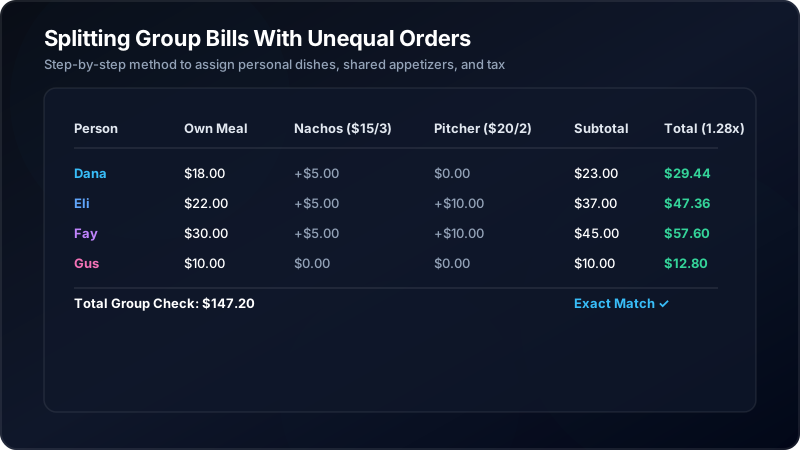
Here’s an example with four friends. Dana ordered an $18 meal. Eli ordered a $22 meal. Fay ordered a $30 meal. Gus ordered a $10 meal. These are their starting amounts before shared items.
Using Initials to Mark Items on the Receipt
Write initials beside each item with a pen. It’s quick and clear. You can also snap a photo and mark it in your phone’s editing tool.
How Do You Divide Shared Items Between Multiple Diners?
Split each shared item only among the people who had it. In our example, Dana, Eli, and Fay shared $15 nachos. That’s $5 each. Eli and Fay also shared a $20 pitcher, so each adds $10.
Now update everyone’s subtotal. The table shows the result.
| Person | Own Meal | Nachos Share | Pitcher Share | Subtotal |
|---|---|---|---|---|
| Dana | $18 | $5 | $0 | $23 |
| Eli | $22 | $5 | $10 | $37 |
| Fay | $30 | $5 | $10 | $45 |
| Gus | $10 | $0 | $0 | $10 |
| Total | $80 | $15 | $20 | $115 |
The $115 matches the receipt subtotal. That’s your first checkpoint.
How Can You Allocate Tax and Tip to Individual Orders?
Combine the tax rate and tip rate into one percentage. Suppose tax is 8% and the group tips 20% on the subtotal. That’s 28% together, so each person multiplies their subtotal by 1.28.
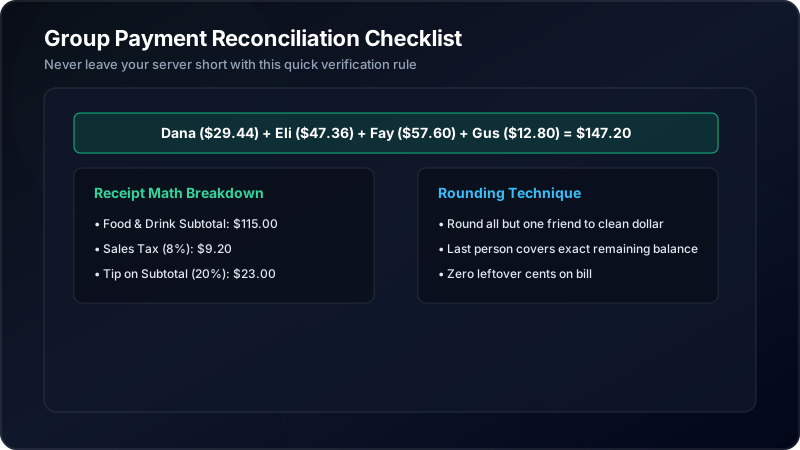
Dana pays $23 × 1.28 = $29.44. Eli pays $37 × 1.28 = $47.36. Fay pays $45 × 1.28 = $57.60. Gus pays $10 × 1.28 = $12.80. The shares add up to $147.20. That equals $115 + $9.20 tax + $23 tip.
What Is the Best Way to Handle Discounts on Different Orders?
Apply each discount to the right person. If Gus had a $4 coupon for his meal, subtract it from his subtotal only. His food cost drops to $6.
Many groups still base the tip on original prices. That keeps the server’s tip whole. So Gus might pay tax on $6 but tip on $10. Decide your rule as a group before calculating. Clear discount share rules prevent confusion.
Sharing a Discount That Covers the Whole Table
Divide the discount in proportion to each subtotal. Someone with a larger order gets a larger part of the savings. That’s the fairest way to split a group-wide coupon.
How Can You Round Each Person’s Amount Without Changing the Total?
Round all but one share. Then let the final person cover the remaining amount. This keeps the total exact.
For example, Dana pays $29.50, Eli pays $47.50, and Fay pays $57.50. That’s $134.50. The total is $147.20, so Gus pays $12.70. Everyone’s close to their exact share, and the bill is fully covered. This small rounding adjustment avoids leftover cents.
How Should You Split a Bill When One Person Pays for Someone Else?
Combine their shares first. If Eli is treating Gus, add Gus’s amount to Eli’s. Eli then pays $47.36 + $12.80 = $60.16.
This keeps the other shares unchanged. It also makes the gift clear and simple. Case study: Picture a birthday dinner where three friends cover the guest of honor. They split her $30 share evenly, adding $10 each to their own amounts. Nobody had to redo the full calculation.
What Is the Fairest Way to Handle Shared Drinks and Appetizers?
Only charge people who actually shared. Someone who skipped the wine shouldn’t pay for it. Mark shared items clearly during the meal.
If sharing was uneven, adjust the split. Say one person ate most of the fries. The group might agree they pay a bigger part. Friendly flexibility matters more than perfect math. Talk it through, and settle quickly.
Tracking Shared Drinks During the Meal
Drinks add up fast. Make a quick note each time a round is ordered. At the end, you’ll know exactly who shared what.
How Can You Reconcile Individual Payments With the Restaurant Receipt?
Add up all payments. The sum should equal the receipt total plus the tip. In our example, that’s $147.20.
If payments fall short, find the gap before leaving. Check for missed items, forgotten tax, or rounding slips. If payments exceed the total, the extra usually just adds to the tip. Payment reconciliation ensures your server gets exactly what the group intended.
Conclusion
Splitting a bill with different orders is easy with a clear plan. Assign each item, split shared dishes among the people who had them, and apply tax and tip as one percentage. Place discounts on the right person, combine shares when someone treats a friend, and round carefully. Finally, match all payments to the receipt. With this method, you can split a restaurant receipt fairly and calmly.