Splitting the Bill Fairly: Step-by-Step
Learn how to split a restaurant check fairly when individual orders vary, handling shared appetizers, proportional tax, and tips smoothly.
Group dinners are fun until the check arrives. One friend had a salad. Another had steak and two cocktails. Splitting evenly suddenly feels unfair. This guide shows how to split a restaurant bill fairly when orders differ. You’ll learn simple ways to handle shared plates, tax, tip, and discounts. Most importantly, you’ll keep friendships intact when the bill shows up.
What Makes a Restaurant Bill Difficult to Split Evenly?
Different orders create different costs. If one person spends $15 and another spends $45, an even split isn’t fair. The lighter eater pays for someone else’s meal.
Shared items make it harder. Appetizers, desserts, and drink pitchers don’t belong to one person. Then tax and tip add another layer. That’s why a clear method matters for any fair bill split.
How Can Each Person Pay for Their Own Food and Drinks?
Start with the itemized bill. Match each item to the person who ordered it. Add up each person’s items to find their food subtotal.
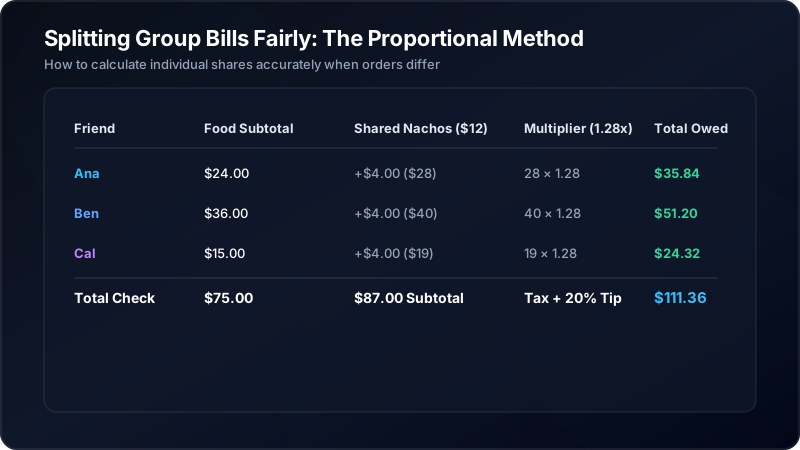
Here’s an example with three friends. Ana ordered $24 in food. Ben ordered $36. Cal ordered $15. Each person’s items form the base of their share. Everything else, like tax and tip, gets added on top of that base.
Asking for Separate Checks Before Ordering
Many restaurants can split checks if you ask early. Tell your server at the start. It saves time later. Some busy restaurants may limit this for large groups, so ask politely.
How Do You Divide Shared Appetizers and Side Dishes?
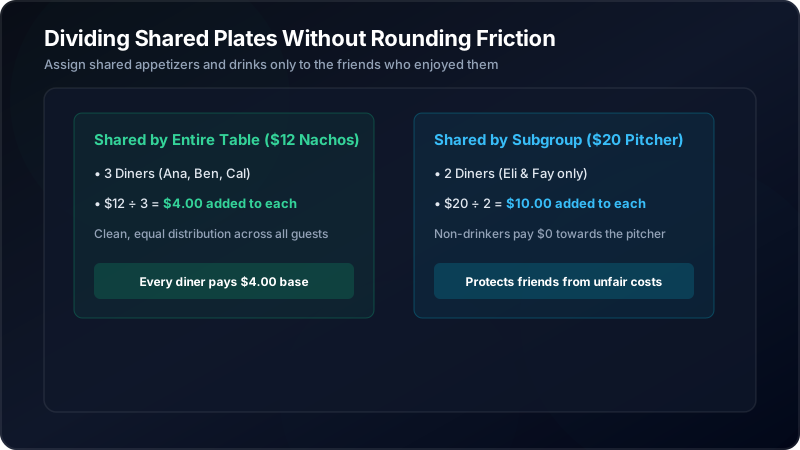
Split each shared item evenly among the people who ate it. In our example, the three friends shared a $12 appetizer. Each pays $4.
Now update each person’s subtotal. Ana has $28, Ben has $40, and Cal has $19. Together, that’s $87, which matches the bill subtotal. This check confirms your shared appetizer cost is divided correctly.
What Is the Easiest Way to Allocate Tax and Tip?
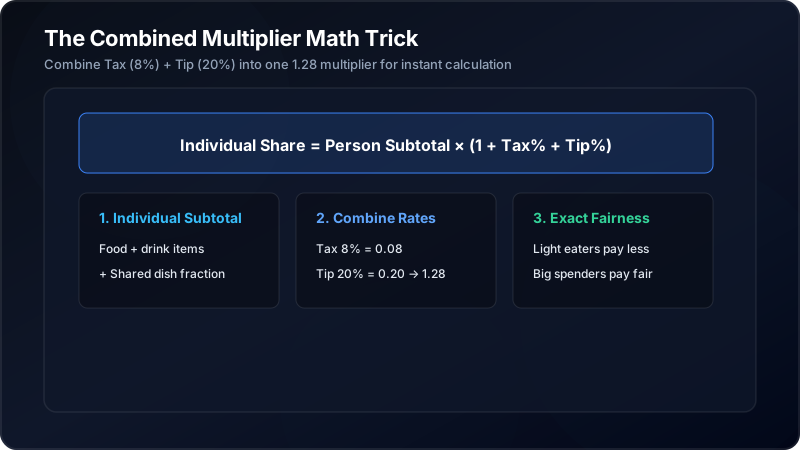
Use one combined percentage. Tax and tip both grow with the bill, so each person pays them in proportion to their subtotal. In our example, tax is 8% and the tip is 20% of the subtotal.
That’s a combined 28%. So multiply each person’s subtotal by 1.28. The table below shows the result.
| Person | Subtotal | × 1.28 | Amount Owed |
|---|---|---|---|
| Ana | $28.00 | 28 × 1.28 | $35.84 |
| Ben | $40.00 | 40 × 1.28 | $51.20 |
| Cal | $19.00 | 19 × 1.28 | $24.32 |
| Total | $87.00 | $111.36 |
The bill total is $87 + $6.96 tax + $17.40 tip = $111.36. It matches perfectly.
How Can You Split a Bill When Some People Used Coupons or Discounts?
Ask who the discount belongs to. If a coupon was for one person’s meal, subtract it from their subtotal only. If it applied to the whole table, split it in proportion to each subtotal.
Keep the tip fair either way. Many diners calculate the tip on the original, pre-discount amount. The server’s work didn’t shrink because of a coupon. Decide this as a group, so everyone understands the discount allocation.
Sharing a Whole-Table Coupon Fairly
Say the group has $10 off the entire bill. Each person’s discount equals their subtotal share. Ana’s share is 28 ÷ 87, or about $3.22. This proportional method keeps things balanced.
How Do You Check That Everyone’s Share Adds Up to the Total?
Add every person’s amount together. The sum must match the receipt total plus the tip. In our example, $35.84 + $51.20 + $24.32 = $111.36.
If there’s a gap, look for missing items or rounding slips. It’s better to find a $2 gap now than to leave the server short. This quick bill reconciliation step protects everyone.
How Should You Handle Items Shared by Only Two or Three People?
Only charge the people who shared the item. If two friends split a $20 bottle of wine, each adds $10. The friend who didn’t drink pays nothing for it.
Write notes on the receipt or in your phone. List each shared item and who shared it. Case study: Picture four coworkers where only two shared a dessert. By marking it on the receipt, they avoided charging the other two. Nobody had to argue later.
What Is the Fairest Method When One Person Ordered Much More Than Everyone Else?
Itemized splitting is almost always fairest. In our example, an even split would be $37.12 each. That means Cal overpays by $12.80, while Ben underpays.
Some groups still prefer even splits for simplicity. That’s fine when orders are close. But when one person orders far more, suggest paying by item. Most people appreciate the fairness, including the big spender.
Speaking Up Kindly About an Uneven Split
A friendly tone helps. Try saying, “Want to just pay for what we each ordered?” This keeps things light. It also makes the fair payment feel like a group choice.
How Can You Split a Bill Quickly Without Creating Rounding Errors?
Round each person’s amount except one. Then let the last person cover whatever remains. This keeps the total exact.
In our example, Ana rounds to $36, and Ben rounds to $51. The total is $111.36, so Cal pays $111.36 − $87 = $24.36. That’s just four cents more than his exact share. Bill splitting apps can also handle the math instantly and track who owes what.
Conclusion
Splitting a bill fairly starts with the itemized receipt. Assign each item, divide shared plates among the people who ate them, and apply tax and tip as one combined percentage. Handle coupons clearly, and always check that the shares match the total. Use smart rounding to finish fast. With these steps, you can split a restaurant bill fairly even when every order is different.