How to Calculate Tip After a Discount
Learn how to calculate tips fairly after discounts, coupons, and vouchers, plus how to handle tax order and large group checks.
Coupons and deals make dining out cheaper. But they also raise a tricky question. Should you tip on the original price or the discounted amount? The answer affects your server’s pay more than you might think. This guide explains how to calculate a tip after a discount step by step. You’ll learn the right order for tax, discounts, and tips, plus how to handle partial coupons and shared bills.
What Amount Should You Use to Calculate a Tip After a Discount?
Most etiquette guidance suggests tipping on the original price. That’s the cost of your meal before any coupon or deal. Your server’s work doesn’t shrink because you paid less.
Think of it this way. The server carried the same plates, answered the same questions, and refilled the same drinks. A discount comes from the restaurant or a promotion, not from the server’s effort. So the pre-discount subtotal is a fair tip base amount.
How Do You Calculate the Discounted Bill Before Adding a Tip?
Start with the original subtotal. Subtract the discount to find what you owe for food. Then add tax, usually calculated on the discounted amount.
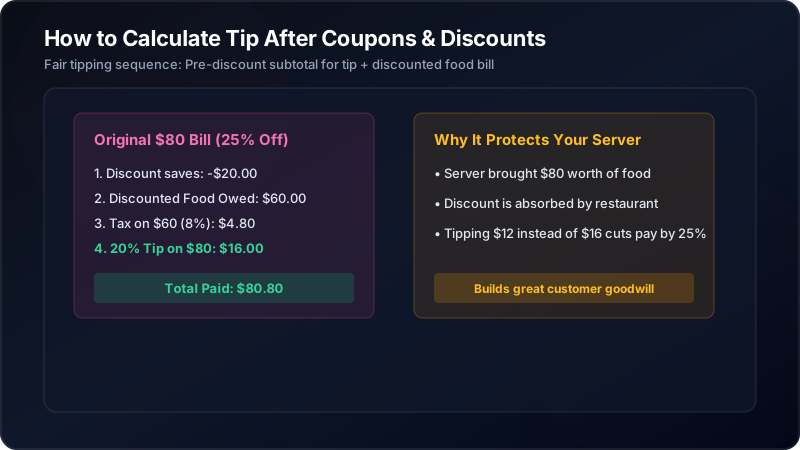
Here’s an example. Your meal costs $80. A 25% coupon saves $20, bringing it to $60. Tax at 8% on $60 is $4.80. So your bill before the tip is $64.80. Next, you’ll calculate the tip on the original $80.
Finding the Discount Amount
For a percentage discount, multiply the original price by the discount rate. A 25% discount on $80 equals $80 × 0.25 = $20. For a fixed coupon, simply use the dollar amount shown.
How Does a Percentage Discount Change the Final Tip?
It depends on which amount you tip on. Using the example above, 20% of the original $80 is $16. But 20% of the discounted $60 is only $12. That’s a $4 difference for your server.
The table below shows how bigger discounts widen the gap.
| Original Bill | Discount | Discounted Bill | 20% Tip on Original | 20% Tip on Discounted |
|---|---|---|---|---|
| $50 | 10% | $45 | $10.00 | $9.00 |
| $80 | 25% | $60 | $16.00 | $12.00 |
| $100 | 50% | $50 | $20.00 | $10.00 |
| $60 | Free entree worth $20 | $40 | $12.00 | $8.00 |
Should You Tip on the Original Price or the Discounted Amount?
Tipping on the original price is widely considered the fair choice. It protects servers when diners use deals, gift offers, or loyalty rewards. Many servers notice when discounts shrink their tips.
That said, tipping is still your decision. If money is tight, tipping on the discounted amount isn’t forbidden. But if you can, use the original price. It’s a kind gesture that keeps your final tip amount fair.
Why Deal Diners Can Leave a Great Impression
Servers sometimes expect lower tips from coupon users. Tipping on the full price breaks that pattern. It also builds goodwill if you return to the same restaurant.
How Can You Calculate Tax, Discount, and Tip in the Correct Order?
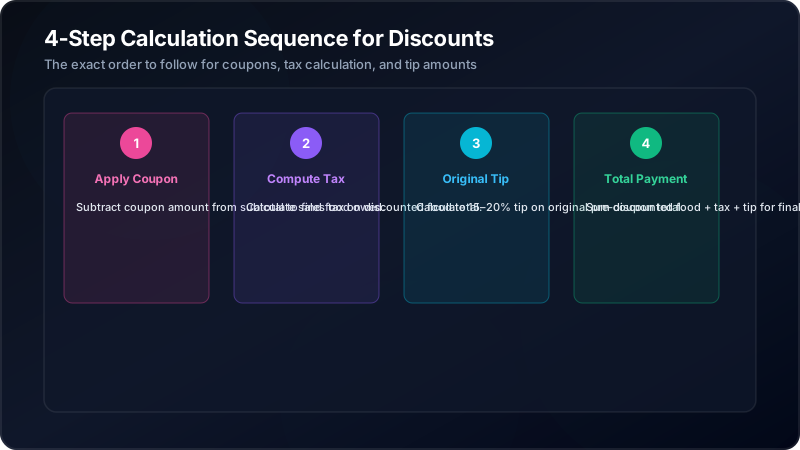
Follow this order. First, apply the discount to the subtotal. Second, calculate tax, which is usually based on the discounted price. Third, calculate the tip on the original subtotal. Finally, add everything together.
Using our example: $60 discounted food + $4.80 tax + $16 tip = $80.80. Tax rules for coupons can vary by state, so check your receipt. It will show exactly how tax was applied. This order keeps your discount and tip calculation clean.
How Do You Check the Final Bill After Applying All Adjustments?
Look at each line on the receipt. Confirm the original subtotal, the discount amount, and the tax. Then add your tip and check the final total.
Ask yourself two questions. Does the discount match the coupon? Does the tip equal your chosen percentage of the original price? Case study: Picture a teacher using a $15 loyalty reward on a $75 dinner. Her receipt shows the discount correctly. She tips 20% on $75, leaving $15. Her server gets a full tip, and her reward still saves money.
Using the Receipt as Your Checklist
The receipt shows every piece you need. Work from top to bottom. Mark each number as you confirm it. This makes errors easy to spot.
What Happens When a Coupon Covers Only Part of the Meal?
Some coupons apply to one item, like a free dessert or a discounted drink. In that case, subtract only that item’s discount. The rest of the bill stays the same.
The tip still uses the full original value. If a free $9 dessert was part of your meal, include that $9 in your tip base. The server still brought it to the table. This simple habit keeps coupon dining fair for everyone.
How Should You Handle Discounts on Shared Restaurant Bills?
First, decide who the discount belongs to. If it’s one person’s coupon, subtract it from their share only. If it applies to the whole table, split the savings in proportion to each person’s order.
Keep the tip on the original total for the group. That way, the server receives the same tip as if no discount applied. Everyone benefits from the savings, but the service is still rewarded fully. This approach helps you split a discounted bill with tip smoothly.
Agreeing on Discount Rules Before You Order
Mention coupons early at group meals. Decide together how savings will be shared. This prevents confusion when the check arrives.
What Should You Do When the Receipt Shows Both Original and Discounted Prices?
Use the original price line for your tip. Many receipts show “subtotal,” then “discount,” then “adjusted subtotal.” The first subtotal is usually the full value of your meal.
If the receipt only shows the discounted price, look at menu prices. Add them up to rebuild the original amount. You can also ask your server. They can explain the receipt and confirm the original total quickly.
Conclusion
Calculating a tip after a discount is simple once you know the order. Subtract the discount, add tax, and tip on the original price. Apply partial coupons only to their items, and split group savings fairly. Always check the receipt line by line. With this method, you can calculate a tip after a discount while keeping your server’s reward fair.
How to Calculate Tip on a Large Group Bill: A Complete Guide
Big group dinners create big bills. With ten people, several orders, and shared plates, the tip question gets complicated fast. Who pays what? Is gratuity already included? This guide explains how to calculate tip on a large group bill clearly. You’ll learn to tip on the full check, split it fairly, handle automatic gratuity, and verify the final amount.
What Makes Tipping on a Large Group Bill Different?
Large groups mean more work for servers. They take more orders, carry more plates, and often handle split payments. So the stakes for a fair tip are higher.
Group bills also bring more room for mistakes. Some diners forget tax, and others under-tip without noticing. Many restaurants respond by adding automatic gratuity for large parties. That’s why reading the bill carefully matters so much.
How Do You Calculate a Tip on the Entire Group Check?
Start with the group subtotal. Multiply it by the tip percentage. Then add the tip and tax to find the total.
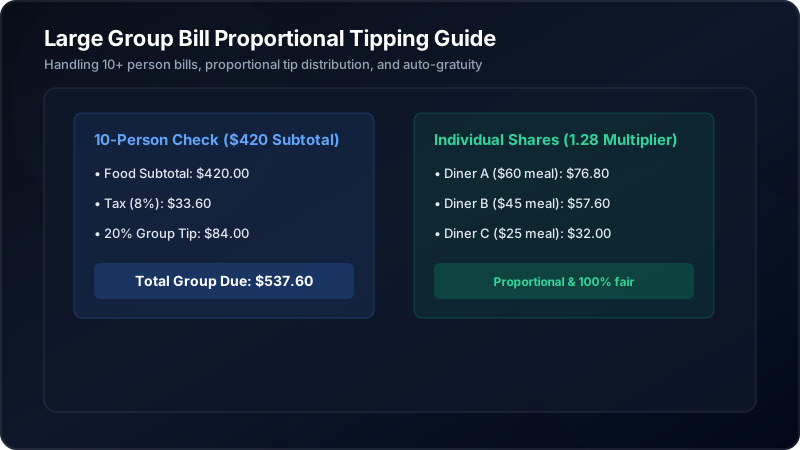
Here’s an example with ten diners. The subtotal is $420. Tax at 8% is $33.60. A 20% tip on the subtotal is $84. The full amount is $420 + $33.60 + $84 = $537.60. That’s the number the group must cover together.
Choosing a Group Tip Percentage
Agree on the rate before the bill arrives. Twenty percent is common in the US for good service. Settling this early avoids debates later.
How Can You Divide the Tip Fairly Among Different Diners?
Each person tips in proportion to what they ordered. Someone with a $60 meal tips more than someone with a $25 meal. That’s fairer than splitting the tip evenly.
The easiest way is to use one combined rate. With 8% tax and a 20% tip, each person multiplies their subtotal by 1.28. The table shows a few examples.
| Diner | Subtotal | × 1.28 | Amount Owed |
|---|---|---|---|
| Diner A | $60 | 60 × 1.28 | $76.80 |
| Diner B | $45 | 45 × 1.28 | $57.60 |
| Diner C | $25 | 25 × 1.28 | $32.00 |
How Do Automatic Gratuity Rules Affect Large Groups?
Many restaurants add automatic gratuity for parties of six or eight people. It’s often 18% to 20%. The menu or bill usually mentions it.
When automatic gratuity appears, the tip may already be covered. Adding another full tip would mean paying twice. Check the bill for words like “gratuity” or “large party service charge.” This step prevents costly double tipping.
How Can You Calculate Tip When Everyone Pays Separately?
Each person calculates their own tip on their own subtotal. Using a 20% rate, a $40 meal needs an $8 tip. A $30 meal needs a $6 tip.
Separate payments can lead to uneven tipping. Some diners forget, while others round down. Remind everyone of the agreed rate before paying. That keeps the group tip percentage on target.
Reminding the Group About the Tip Rate
A short message helps. Try saying, “We’re all doing 20% on our own orders.” This keeps everyone on the same page without sounding pushy.
How Do You Verify That the Group’s Tip Matches the Intended Percentage?
Add up every tip. Then divide by the group subtotal. The result should match your chosen rate.
In our example, the tips should add up to $84. Dividing $84 by $420 gives 0.20, or 20%. If the tips only reach $70, that’s about 16.7%. Case study: Picture a team dinner where a coworker checks the tip total. She finds the group is $14 short and asks everyone to add a little. The server receives the full 20% as planned.
What Should You Do When a Large-Party Gratuity Is Already Included?
Read the amount and percentage on the bill. If the gratuity is 18% and your group wanted 20%, you can add the difference. On a $420 subtotal, 18% is $75.60. Adding $8.40 brings it to 20%.
If service was great, you may add a bit more. If the included gratuity already matches your goal, you’re done. Don’t let a tip line on the receipt pressure you into tipping twice. An included gratuity usually means the tip is covered.
Asking Where Automatic Gratuity Goes
Policies vary by restaurant. Some pass the full gratuity to staff. If you want to be sure, ask politely. It’s a reasonable question.
How Can You Handle Different Orders When One Tip Percentage Applies to Everyone?
Apply the same percentage to each person’s subtotal. This keeps things fair and consistent. Big spenders tip more, and light eaters tip less.
Shared items need splitting first. Divide appetizers and pitchers among the people who shared them. Then apply the tip rate to each updated subtotal. This approach helps you calculate tip with different orders smoothly.
What Happens When the Group Bill Includes Discounts, Shared Items, and Fees?
Handle each piece in order. First, split shared items among those who enjoyed them. Next, apply discounts to the right people or divide group discounts proportionally. Then calculate tax and tip.
Many groups tip on the original subtotal, before discounts. Fees like service charges may already cover part of the tip. Other fees, like card surcharges, usually stay out of the tip base. Keeping this order clear avoids confusion for everyone at the table.
Working Through a Complex Group Bill Calmly
Pick one person to handle the math. Give them the receipt and let others confirm their items. A calm, organized approach keeps the evening friendly.
Conclusion
Tipping on a large group bill takes a clear plan. Agree on a tip rate early, calculate tips in proportion to each order, and watch for automatic gratuity. Split shared items first, handle discounts and fees carefully, and verify the tip total against the subtotal. With these steps, you can calculate and split a tip on a large group bill fairly and without stress.